YAMAHA 8CJ-14100-00-00 Carburetor Assy. P/n
fits model: Vmax, Xt, 500. make: Yamaha. year: 1998.
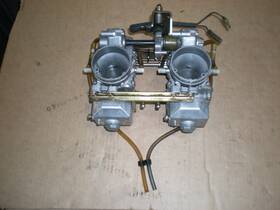
( Manufacturer Part Number: 8CJ-14100-00-00 ), ( Part Type: Carburetor ), ( Country Of Origin: United States )
Review YAMAHA Carburetor Assy. P/n fits VMAX XT 500 1998
The **Yamaha 8CJ-14100-00-00 carburetor** is a precision-engineered component designed exclusively for the legendary **1998 Yamaha V-Max 500XT**, a high-performance cruiser that blends raw power with classic American motorcycle styling. This **air-cooled, single-cylinder carburetor** plays a critical role in delivering optimal fuel-air mixture to the engine, ensuring smooth throttle response, peak horsepower, and reliable performance across a wide range of riding conditions. Built to Yamaha s exacting standards, the **8CJ-14100-00-00** features a robust **aluminum body** with a **durable gasket system** to prevent leaks and maintain vacuum integrity, while its **precision-machined internals** including the **floating bowl, throttle body, and pilot jet assembly** are designed for longevity and consistent fuel delivery. The carburetor incorporates Yamaha s **proven CV carburetor design**, which utilizes a **constant velocity venturi** to dynamically adjust fuel flow based on engine demands, providing a seamless transition from idle to full throttle. Whether cruising on the highway or navigating tight city streets, this carburetor ensures the V-Max s **500cc inline-four engine** operates at its best, offering a balance of torque and efficiency that defines the bike s aggressive yet refined character. For riders seeking to restore or upgrade their 1998 V-Max, this **OEM replacement part** is a must-have, guaranteeing compatibility, performance, and the timeless reliability Yamaha is known for.
The **Yamaha 8CJ-14100-00-00** is a carburetor designed for the **1998 Yamaha V-Max 500XT**, a popular cruiser-style motorcycle. Below is a detailed breakdown of its pros and cons, followed by a conclusion and recommendation.
---
### **Pros of the Yamaha 8CJ-14100-00-00 Carburetor**
1. **OEM Quality and Reliability**
The carburetor is an original Yamaha part, meaning it is built to the manufacturer s specifications. Yamaha has a reputation for durable, well-engineered components, which suggests this carburetor will perform consistently under normal riding conditions.
2. **Proven Performance**
The V-Max 500XT is a well-regarded bike, and its carburetion system is designed to deliver smooth power delivery, especially for its cruiser-style riding characteristics. The 8CJ carburetor is optimized for this engine, providing a balanced mix of throttle response and fuel efficiency.
3. **Ease of Maintenance and Tuning**
Yamaha carburetors are relatively straightforward to service and adjust. The 8CJ is a single-carburetor design (though the V-Max 500XT typically uses two, this part number likely refers to one of them), which simplifies maintenance compared to more complex multi-carb setups. Basic adjustments like idle speed, jet sizing, and float level can be made with standard tools.
4. **Availability of Replacement Parts**
As an older but still widely owned bike, parts like this carburetor and associated components (jets, gaskets, diaphragms) are relatively easy to find. Yamaha s legacy parts market ensures that you won t struggle to source replacements if needed.
5. **Cost-Effective for a Replacement**
Compared to aftermarket carburetors or full engine rebuilds, replacing a worn-out carburetor is a cost-effective solution. The 8CJ-14100-00-00 is priced reasonably, especially when compared to the labor costs of more extensive repairs.
6. **Compatibility with Modifications**
If you plan to modify your V-Max 500XT (e.g., exhaust, intake, or electronic ignition upgrades), the stock carburetor can often be tuned to work well with these changes. Many riders successfully pair it with performance parts without needing a full carburetor swap.
7. **Durability for the V-Max s Riding Style**
The V-Max 500XT is known for its heavy-duty cruising and occasional high-speed use. The 8CJ carburetor is robust enough to handle the bike s typical workload, provided it is properly maintained.
---
### **Cons of the Yamaha 8CJ-14100-00-00 Carburetor**
1. **Age-Related Wear and Potential Leaks**
The carburetor is from the late 1990s, and like all mechanical components, it may develop leaks, clogs, or internal wear over time. Common issues include:
- **Diaphragm failure** (causing rough idle or poor throttle response).
- **Sticky or dirty jets** (leading to fuel starvation or flooding).
- **O-ring or gasket degradation** (resulting in vacuum leaks or fuel leaks).
These problems are fixable but require periodic inspection and cleaning.
2. **Sensitivity to Fuel Quality**
Older carburetors like the 8CJ can be sensitive to low-quality or ethanol-blended fuels, which may cause clogging or inconsistent performance. Regular use of high-quality fuel and carburetor cleaners (e.g., Sea Foam or Techron) is recommended.
3. **Limited Throttle Response Compared to Modern Systems**
The 8CJ carburetor lacks the precision and electronic tuning of modern fuel injection systems. If you prioritize instant throttle response or high-performance riding, you may find the carburetor less responsive, especially under heavy load or at high RPMs.
4. **Maintenance Requirements**
Carburetors require more frequent maintenance than fuel-injected systems. Key tasks include:- **Cleaning the air filter** regularly to prevent dirt from entering the carburetor.
- **Adjusting the idle mixture** and idle speed periodically.
- **Replacing diaphragms, gaskets, and jets** as they wear out (typically every 5,000 10,000 miles or as needed).
Neglecting these tasks can lead to poor performance or engine damage.
5. **Potential for Tuning Challenges**
While the 8CJ can be tuned, achieving optimal performance may require trial and error with jet sizes, idle screws, and float levels. This can be frustrating for riders who prefer plug-and-play solutions like fuel injection.
6. **Environmental and Emissions Concerns**
Older carburetors like this one are not designed with modern emissions regulations in mind. If you ride in areas with strict emissions testing (e.g., California s smog checks), you may need to ensure the carburetor is in perfect working order to pass inspections.
7. **Limited Longevity Compared to Fuel Injection**
While durable, carburetors generally have a shorter lifespan than fuel-injected systems, especially in bikes that see heavy use. Over time, the risk of failure increases, potentially leading to more frequent replacements or repairs.
---
### **Conclusion**
The **Yamaha 8CJ-14100-00-00 carburetor** is a solid, reliable choice for the 1998 V-Max 500XT if you prioritize simplicity, cost-effectiveness, and ease of maintenance. It offers OEM quality, proven performance, and straightforward tunability, making it a practical option for riders who enjoy cruising and occasional high-speed riding. However, it requires regular upkeep to avoid issues like leaks, clogs, or poor throttle response. If you re comfortable with basic carburetor maintenance and don t mind its limitations compared to modern systems, this part is a worthwhile investment.
For riders who prefer low maintenance or high-performance tuning, alternatives like aftermarket carburetors (e.g., Keihin or Mikuni) or a full fuel injection conversion might be worth considering. However, for most V-Max 500XT owners, the 8CJ remains a practical and cost-effective solution.
---
### **Recommendation**
- **Buy the 8CJ-14100-00-00 if:**- You want an OEM replacement with proven reliability.
- You re comfortable with basic carburetor maintenance (cleaning, adjusting, and occasional part replacements).
- You ride primarily for cruising and don t require extreme performance.
- You can source high-quality fuel and perform regular upkeep.
- **Consider alternatives if:**- You want a more modern, low-maintenance system (e.g., fuel injection).
- You ride aggressively or modify your bike extensively (aftermarket carburetors may offer better tuning flexibility).
- You live in an area with strict emissions regulations and want to avoid potential tuning challenges.
- **Before purchasing, ensure:**- The carburetor is in good condition (check for leaks, cleanliness, and diaphragm integrity if possible).
- You have access to replacement parts like jets, gaskets, and diaphragms.
- You re prepared to perform routine maintenance (e.g., cleaning the carburetor every 5,000 10,000 miles).
In summary, the 8CJ-14100-00-00 is a sound choice for the V-Max 500XT, provided you re willing to put in the effort to keep it running smoothly. For those seeking a hassle-free experience, exploring fuel injection or high-quality aftermarket carburetors may be preferable.
Details:
Ocher enterprises now offers a full line of aftermarket ATV / UTV Wave runner Dirt bike Street bike Snowmobile Parts. This item is for sale locally as well, so I reserve the right to end this listing at any time. The carburetor assembly is in good condition as shown the photos. This sale is for one used carburetor assembly off a 1998 Yamaha VMAX 500 XT.
Yamaha part number 8CJ-14100-00-00.
part #: 8cj141000000 price
- $181.67
specifications exhaustsnowmobilee:
- for models: Vmax, Xt, 500
- for makes: Yamaha
- for years: 1998
- mpn: 8cj-14100-00-00
- part type: Carburetor
- country of origin: United States
general exhaustsnowmobilee:
- Parts Accessories > Snowmobile Parts > Exhaust
- condition: Used
payments exhaustsnowmobilee:
- credit card: Discover
- other
- wallet: Google-pay
offer exhaustsnowmobilee:
- started: March 29, 2026
- sold: 0
- options: Ship-to-home
- availability: In Stock
- best offers: True
- quantity: 1
shipping exhaustsnowmobilee:
- service: Standard
- class: Standard
- transit: 3-6 Days
- type: Fixed
- cost: $12.00
seller exhaustsnowmobilee:
- city: Sussex, Wisconsin
- # reviews: 2609
- rating: 100.0%
returns exhaustsnowmobilee:
- paid by: Buyer
- policy: Returns Accepted
- time: 14 Days
Yamaha 8CJ-14100-00-00 Is Similar To:
- 839-14610 Yamaha Nos Snowmobile Exhaust Pipe Assembly (31.9% similar) String gaskets are not included exhaust...(November 27th, 2018)
- 841-14610 Yamaha Nos Snowmobile Exhaust Pipe Assembly (31.9% similar) New - paint has some blames...(November 26th, 2018)
- 84m-13555-00-00 Yamaha Carburetor Intake Manifold Boot Clamp Exciter Ii (38.2% similar) Needs cleaned. We answer all inquiries. Open communication. Comes as shown...(March 8th, 2019)
- 89a-14630-01-00 Not Specified Yamaha Vmax St Exhaust Expansion Chamber Pipe (31.1% similar) Removed from: 1992 yamaha vmax VX750 with miles please review all pictures to assess the condition of item...(March 5th, 2019)
- Vmax-4 89a-14620-01-00 Yamaha 750 1992 Tuned Pipe Exhaust 1992-1994 (26.8% similar) What you see on the picture is what you get...(August 1st, 2016)
- 8ab-14710-00-00 Yamaha Vmax V Max 500 (45.4% similar) ...(March 8th, 2017)
- 8cr-14620-00-00 Yamaha Vmax 500 600 (48.4% similar) Fits vmax ,mm and VT500 part 8CR which was superseded to has some dents, see photos. Used yamaha snowmobile exhaust pipe...(December 22nd, 2017)
- 8cr-14640-00-00 Yamaha Vmax Sx Xt (47.3% similar) Good used silencer for yamaha twin pro action chassis. The part SW removed from a 1998 yamaha venture 600 with no cracks...(January 19th, 2018)
- 500-600 8cr-14610-00-00 1997-2001 Yamaha Sx500 Vmax 500-600 Mm600 Venture 500-600 Etc Exhaust Pipe (45.6% similar) There is no charge for this service. Condition exhaust pipe is in good used condition with no cracks or damage. Combine offers and save on shipping. Some light and average cosmetic wear and a few dings. Northern parts recreation yamaha SX500 exhaust pipe, 2001 yamaha SX500R exhaust, 1997 yamaha ...(October 2nd, 2016)
- 5120412d 8cr-14640-01-00 Yamaha Vmax V Max Venture 500 600 97-01 Exhaust Muffler (30% similar) May fit other years model's, do your research first. Economises Sir Le pix Du transport, Velez Church vows pi Ce's treatment nitre boutique Bonneville, Que Beck, Canada...(April 8th, 2016)
- 8f2-14633 Yamaha Nos Snowmobile Exhaust Ring Vmax Mm (25% similar) Part: 8F2-14633 prices...(March 7th, 2018)